I found that film extremely moving and have been hoping that Big Big Train could work with Love ever since. The release of Brew and Burgh as a single gave the perfect opportunity.
I was lucky enough to see Love’s film for Brew and Burgh develop over several weeks. Love then kindly agreed to an interview where he gives insight into the animation film-making process.

GMS: Can you tell me something about yourself and your background in animation?
LF: I’m a 30-something year old guy living in Stockholm, Sweden. I work as a VFX-artist and video-editor at a production company that produces commercials and have been doing that for about 12 years or so. Besides working I have a bunch of creative hobbies I’ll spend my free time manically indulged in. Either I’m in my workshop building different kinds of string instruments, or I’m writing and/or recording music, or I’m painting something, or sewing something, or I’m gigging with my pirate band “Stormfrun”, or animating a video, or whatever seems super-interesting at the moment.
For my entire life I’ve had a strong urge to express myself creatively, but never really settled for a particular medium. The passion for animation probably started some time in my childhood when I got hold of a VHS-camera and started making stop motion films. As a teenager it evolved into digital animations for homemade computer games. In my early twenties I found myself as an intern at a television production company and discovered the post-production process and got super interested in that when I realised how software could be used to make animations. After the internship was over I stayed at the company for about a year contributing in different ways to the productions. From making “Lower thirds” for reality series, to animations and music for kid shows. Then I left to study at a media school to learn more about the business I’d somehow found myself in. That led me into the dark side of the industry that is commercials. I actually find it quite enjoyable despite the sometimes soullessness of the content. I get to work with lots of talented people and the projects are plentiful, short and vary a lot. However it’s mostly live action projects nowadays, so I have to get my animation fix elsewhere.
GMS: when we commissioned you to make the film for Brew and Burgh, the brief we gave you was very sketchy. I remember mentioning a couple of visual ideas (a mead hall and a river) and that the song was about individuals coming together to make something before having to go their own way, but that was basically all you had to go on. Tell me about the process of moving from a very sketchy brief to conceptualising the narrative and design of the film.
LF: Good question, I don’t think I’ve ever tried describing that process before but I’ll give it a try! At the start of the process it’s probably more about excluding a bunch of ideas and trying to set up creative boundaries for the project. But also looking at a bunch of inspirational artwork. I ended up looking a lot on works by Eyvind Earle, Tove Jansson and Roger Dean. But also others which I’ve already forgotten the names of. The idea of using an all-animal cast for the film came quite early. Animals are great for telling stories that are relatable to a wide range of people. Kind of ironic, but I mean who doesn’t like animals? I also knew that this was going to be a personal story and in the same way the sci-fi or fantasy genres are effective at describing issues at a societal level, animals are great when focusing on personal interactions and relationships between individuals. Even though I found inspiration in both Watership Down and Animal Farm, I decided on having less humanised animal characters for the video and let the audience do some of the anthropomorphisation instead. I approached the graphical style of the characters in a similar way. I reduced the shapes that make up the different animals to the bare minimum that I found workable while still kind of anatomically correct, relying on the viewers minds to fill-in the blanks. After setting the creative boundries and finding a style I began listening to the song on repeat and tried to visualize the different scenes that would make up the story of the fellowship, the mead hall and the river. I was helped a lot by my girlfriend (Yuki Larsson) during this process, bouncing ideas back and forth. I then made rough sketches of all the scenes I wanted to have and edited them to the song to get a feeling for the timing. After that I said goodbye to life outside the film and started animating!
GS: when you say rough sketches, do you mean drawing by hand, or are those created on the computer?
LF: All art for the video is drawn by hand, but digitally, on a Huion Kamvas pro 24 in Adobe Photoshop and Illustrator. And so are the sketches. Well except for the snowflakes and fire animations which are simulated using different particle systems.
GMS: it’s very difficult for people who are not in the animation world to understand how films are created. Could you talk me through some of the animation processes?
LF: the best way to do this is to give some examples of work-in-progress. Here’s a demonstration of how the backgrounds are drawn. Unfortunately, the one background I decided to screen-capture while drawing I ended up changing a lot later on, so the clip below ended up a little differently but it gives a good idea of how work progresses:
Here’s another demonstration of the creation of a background using screenshots:

And here’s a demonstration of those rough sketches compared to the final frames:

As regards movement, here’s a demonstration of an animation technique I used for a couple of scenes called “rotoscoping”. I’ve basically “borrowed” a video of a running deer, superimposed it over my illustration of the deer in the video and used it as a guide when animating the illustrated deer frame by frame

You get to a certain age and, however hard you try, a certain sense of jaundice can set in, wholly unrelated to the state of your liver. It’s easy to start believing all the great films have been made, the great books written. In particular, that all the great records have been made – anybody who has ever caught themselves repeating their dad’s incredulous, “You call that music?” response to a child’s music playlists will know the feeling.
Such a line of thought is, of course, total nonsense. As long as there are people to draw breath and to snap the mental synapses, there will be fresh ideas, new work to produce and to seek out. Even if certain new genres of music don’t hit the spot, there are still plenty of artists out there with a winning way of splicing words, melodies and chords together to produce work that can do more than simply clamber onto the shoulders of giants past but stand side by side with them instead.
Big Big Train are living proof of that. The possessors of a hefty body of work already, the last decade has seen them knee deep in a purple patch that shows no sign of fading in time’s wash. In recent years they have emerged from the shadows and returned to live performance, receiving the wider acclaim they have long deserved, but many is the new found fan who, on working through the back catalogue, has found pearls aplenty to enjoy.
On arriving at “The Underfall Yard”, it’s a jaded music fan indeed who doesn’t respond with slack jawed amazement for it is a truly monumental beast. Cohesive, melodic, inventive, experimental, prodigious in its ambition, intelligent in its subject matter, shattering in its emotional clout, it is the kind of offering that comes along but rarely in a musical lifetime.
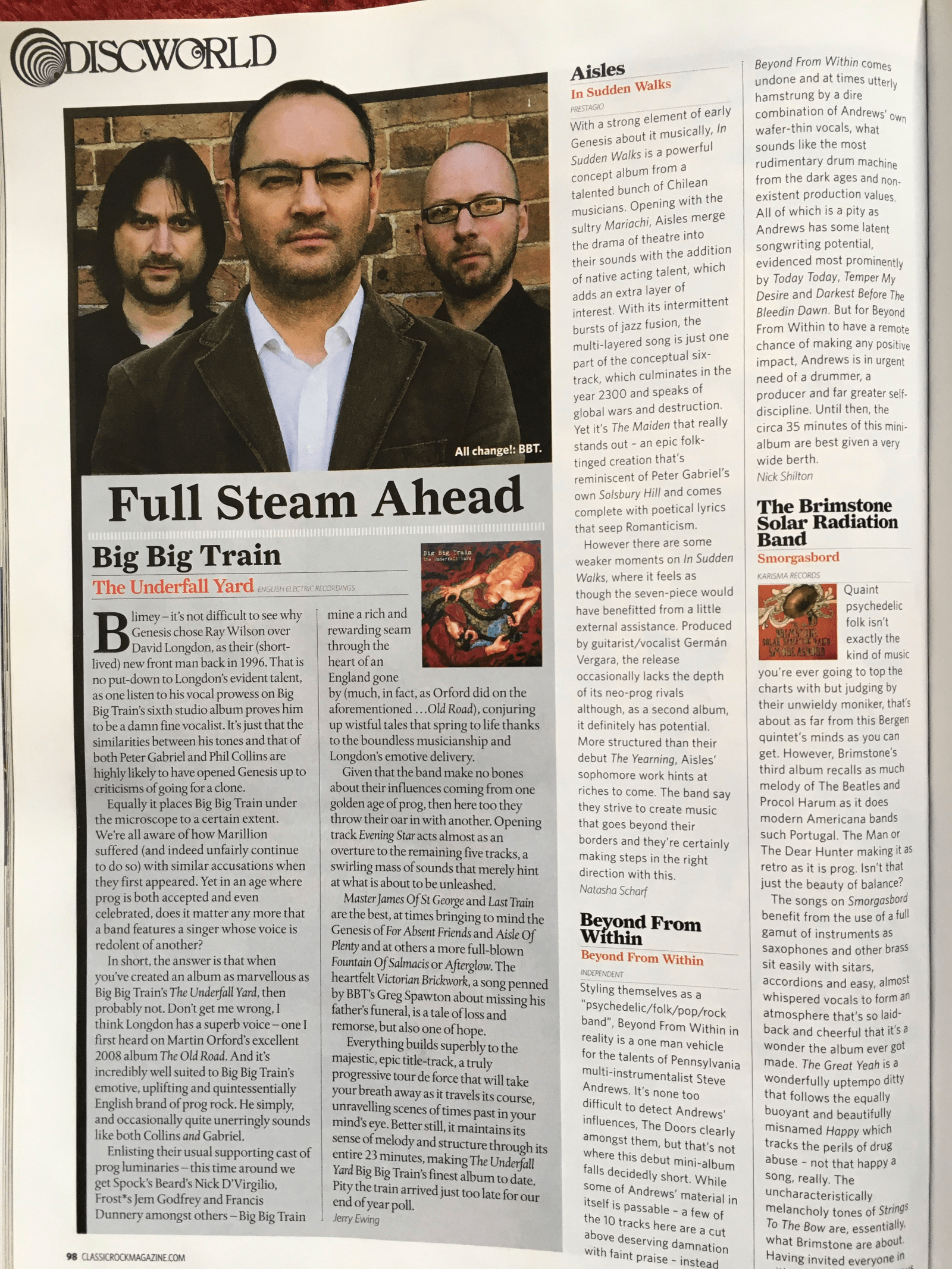
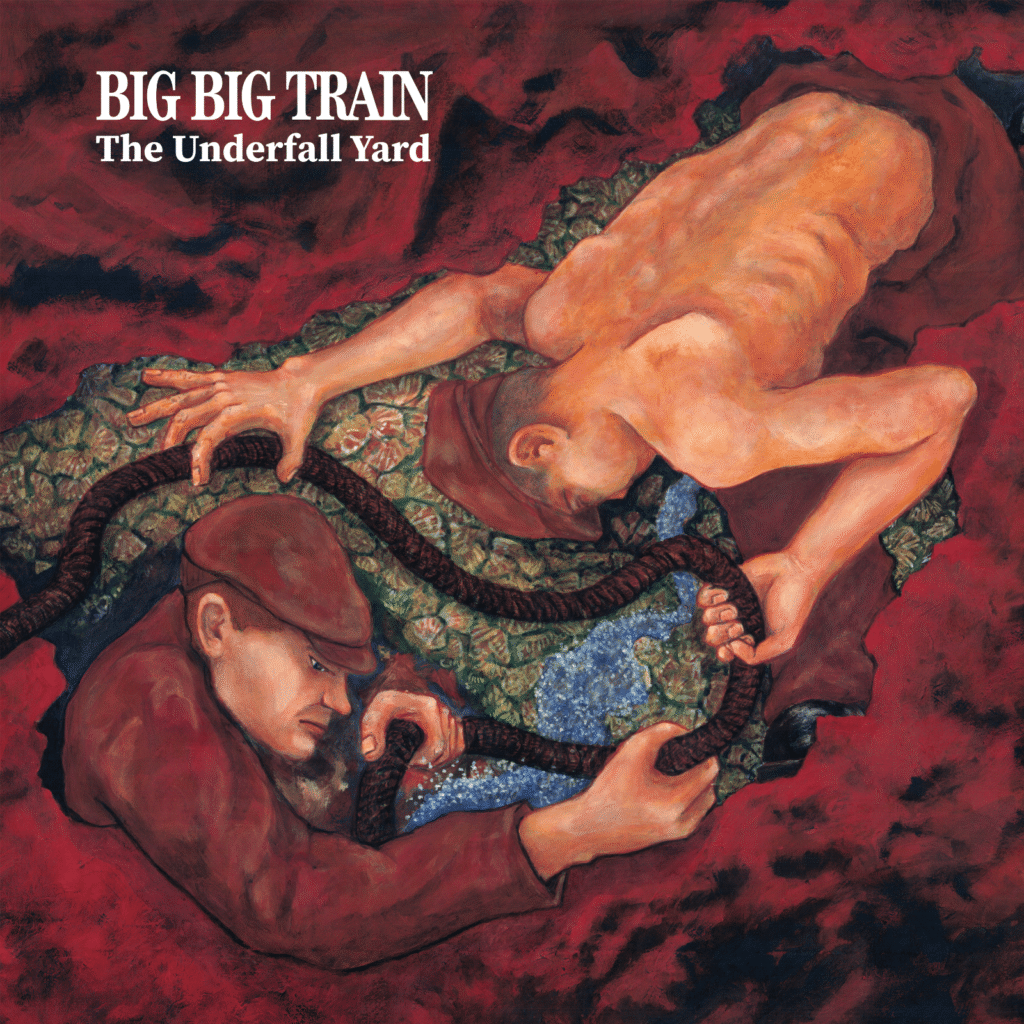
First released on the cusp of Christmas 2009, there’s now a fresh opportunity to re-evaluate the album and its legacy with the release of a remastered and remixed version of the album, along with all the bonus trimmings, on double CD and a properly proggy triple vinyl package. It was the need for a vinyl version of the album that drove this new reissue, as Gregory Spawton explains.
“It was a weird quirk of timing that “The Underfall Yard” missed the resurgence in vinyl and it’s never been available in that format. It’s still our biggest selling album and we have had hundreds of requests over the years for a vinyl version. When we decided we would do it, we wanted to do the job properly, to have a really special release and do something new with the CD version at the same time. It was supposed to be a tenth anniversary release, which would have been December 2019, but because we decided to go back into the multi-tracks and to remix it from the ground up, it became apparent that wasn’t going to happen. Instead, we just concentrated our energies in getting it right and creating something beautiful.
“If we’d just remastered it, the change would have been in the dynamic range, which would have been an improvement. When we did it originally in 2009, it was mastered fairly hot, as was the way at that point, so if we’d just been remastering, we’d have reset things, gone back to the pre-mastered files and we would have had a warmer sounding record. We did that with the “Far Skies, Deep Time” EP and that made an incredible difference. Remastering really can draw music out if it’s done well.
“But we felt that “The Underfall Yard” is the crown jewel in our back catalogue, unlike, for example, “Bard” (!), so we wanted to really go for it and chose to go for the remix too. We’re ten years and more away from it, Rob Aubrey has had ten years more experience in the studio but also, he’s got more time with it now than originally because we were working on an incredibly tight budget then. That additional time, that opportunity to take everything back to zero and approach it again has been very worthwhile.
“We’ve taken a lot of care over it. Rob finished the mixes in November 2020 and they were due to go off in early January 2021. A week or so before they were due to be sent away, I said to Rob, “Why don’t you go back into the mixes, have one more listen and just see if there’s anything else there now that you’ve had some time away from it.” He did and came back wanting to make a few little tweaks and those changes that came at the eleventh hour have been as important as anything else in the process. For me, he identified a couple of crucial musical moments where things have now gone up a level.”
The very idea that the album is being remixed will, inevitably, raise the hackles of some long-term fans who worry that tampering with presumed perfection can only end in tears. On that point, let me assure you that, to my ears anyway, the remix is akin to a sympathetic restoration of an old painting, allowing the light in on fresh little elements that might have been buried before. It’s a delightfully subtle but wholly worthwhile piece of work. But don’t take my word for it – Greg was well aware of the dangers inherent in the project and was determined they should be avoided.
“I understand how fans worry that you’re tampering with something they’ve lived with for ten years, but over the last few years, the various remixes of things by Yes, Jethro Tull, King Crimson and so on has made it a more acceptable idea in general.
“When it’s done well, it can be so beneficial. For me, Yes’ “Gates Of Delirium” is a perfect example of that. For the remix, they lost some of the battle noises that were on the original, which I always found intrusive. I always felt that song was a poorly mixed masterpiece where the new version now is a masterpiece, plain and simple.
“Of course, that judgement is always going to be a subjective one and I had some of those concerns going into this given that it was mostly my baby really. It’s an album I’ve held close to me, perhaps too close at times. I’ve kept a close ear on it as work went on and I do think we’ve got it right. Listening to it incessantly at the end of the process to approve the final versions for the various formats, I’ve found it connecting with me in an emotional way. Having been so closely involved in its creation, having heard it a million times since, I’m very pleased with that, it’s still hitting me fairly fresh.”
That’s not surprising for “The Underfall Yard” stands as a remarkable piece of work, not least because a new Big Big Train was forming around them as they put it together, going from what was an essentially loose collective of musicians held together by Spawton and Andy Poole into something that became a fully-fledged band in the traditional sense. Added to that, they were introducing their fans to a new singer, an enterprise fraught with danger for any band, David Longdon replacing Sean Filkins behind the microphone. That was a change that Big Big Train confronted in typically idiosyncratic fashion on album opener “Evening Star”.
““Evening Star” was a good way of introducing David’s voice, without going straight into a song. I originally wanted it to open with that electric piano line, which was a low-key start, I admit, but Andy suggested putting the voice there first and foremost, since it would be the first time people heard David with us. We took it from a section of backing vocals that was later used in the “The Underfall Yard” itself, this big wall of voices, a very warm sound.
“That song works as an introduction, a big open sound, an overture really if you want to talk in those terms. If you think back to the late ‘70s, saying things like you were writing and releasing an overture would have been laughed at but I think in progressive music nowadays, who cares? I think we’re at a point where we can enjoy the grandeur of some of it, both at face value and, to those of a more delicate disposition, almost in an ironic way.
“Fans had far less of a sense of humour about these things in the ‘70s, it was very tribal – thinking back to when The Buggles joined Yes, people took it very badly, in this country especially, and yet nowadays, people are in and out of bands and you have all kinds of unlikely combinations which seem far more acceptable.
“Those were interesting days, were they not, because it was all a bit puritanical, but equally, progressive rock became very much a dirty word. I remember Steve Hackett going off and doing “Cured” which was a bit more commercial and stripped down and so you saw even the artists themselves running away from what they were good at, no doubt at the request of the record companies.
“What’s nice in the progressive scene now is that there is no divide between old and new bands, the old guard are aware of new artists and there’s a lot of cross-fertilisation. It’s a good time for progressive music now, but it’s been a long time coming.
“Danny Baker did a TV show about the decades of music and when he covered the ‘70s, halfway through, he said, “Right, the elephant in the room is prog, let’s talk about it.” The guests looked horrified and then the more they talked, the more they all agreed they really liked Pink Floyd or Yes or Genesis. They couldn’t admit to that for years, but now the climate is a lot healthier.
“We weren’t in the position that some of those earlier bands were in when they were changing singers, but we were aware that David coming in was a big shift because introducing a new singer is always a big move and people will take it in different ways.
“David’s voice is exceptionally good and I think he took us into areas where more people are prepared to give us a listen than might otherwise do so because his voice is a thing of beauty. People will be willing to invest time in listening to something like “East Coast Racer” because of that even if they maybe have no real interest in progressive music. With some harder edged singers, it can be tougher to break that door down.”
The arrival of Longdon in the band could not have been more timely for they were finding themselves moving away from the edgier material of Filkins’ last stand, “The Difference Machine”. It’s a fascinating record, but it’s a demanding one, not the easiest to live with. According to Greg, that musical shift was something of a happy accident.
““The Difference Machine” is our most out-there piece of work. Over the years, I find that most albums emerge from the ending of the previous one, there’s a trail. We are always writing, so often you’ll find that at the end of one album, you have a number of things that are half-formed and they go forward to the next one. But “The Difference Machine” stands out a little bit. If you’d asked me what the next record was going to sound like as we released “Difference Machine”, I’d have said it was going to be a progression from that, exploring more Van der Graaf Generator kind of territory if you want a shorthand for it.
“But what happened was that we got side-tracked with re-releasing “English Boy Wonders” and we spent an awful lot of time re-recording a lot of that. Working back through the songs, I found that I really liked that album and ended up relearning things from it. It triggered a few ideas about the things that I used to like writing about, it reinforced things and perhaps changed our direction going forwards. Without that process, I think we would have gone into heavier territory. Instead, we put a foot back into slightly more melodic waters. That’s always been there, we’ve always liked the great pop bands like The Beatles, XTC, Prefab Sprout and so on, and that came a bit more to the fore.
“In addition to that, “The Underfall Yard” gained an identity because we had begun to become a band by the end of the process. We’d almost rejected the concept of BBT being an actual band in the mid ‘90s and, as it became more or less myself and Andy, we were prepared to work with whoever we felt could help us achieve what we wanted.
“We experimented with lots of different players and then, by accident, for “The Underfall Yard”, we gathered around us the core of a new approach. It sounds horribly pretentious to say, but the band was almost reborn, we found people that we really like as human beings but who are very talented too, and that process continued with bringing Danny and Rachel in for “English Electric” and Rikard for Stone and Steel. And almost before we knew it, we were back on stage as a fully-flown band again. The difference being we now had an audience, unlike the early days where it was often two men and a dog.
“But to be honest, there was no great masterplan going into “The Underfall Yard”. Any album project takes on its form during the writing because even if you start with a plan, you get side-tracked into other areas. I was just writing songs, I found a couple of ways of working so that the story songs began to come out, which worked really well for me as a writer, there were songs with a personal take on there as well, but there was no overarching idea.
“As the album starts to coalesce, you do things that pull it together, so “Evening Star” was the last thing that was written, and that was drawing themes together to make a statement at the start. That gives it an identity as an album rather than it just being a collection of songs.”
Wordless it might be, but “Evening Star” lacks no power for that, leading into another song where the entire lyric is made up of just 26 words, “Master James of St George”, which in turn leaks into “Victorian Brickwork”, a coupling of two deeply personal songs.
“I’ve written a few personal songs about Barry, the man that brought me up in the first 10 or 11 years of my life. “Boxgrove Man”, “Pick Up If You’re There” and “Master James” and “Victorian Brickwork” are as well as well. My parents got divorced when I was about 11 or 12. I grew up in Sutton Coldfield and had a fantastic free-range childhood. Sutton Park is a great place to explore, that’s where I spent my childhood, but there were some dark times at home.
“My parents divorced and I then had what in those days was a typical Sunday morning relationship with Barry. He lived somewhere else and I saw him on Sundays. The crazy thing is that while I was close to him when he lived at home, I started to resent seeing him even once a week because for me, the world was about being in the woods with my friends, so spending a couple of hours with him seemed very constraining and the relationship slid downhill from there. I got older, I went to university etc etc, there was more and more distance between us and by the end of his life we were calling each other once every three or four years, that was it.
“I had the “Master James” title for many, many years but I didn’t know what the song was going to be about. He was the great castle builder of Edward I’s era. Barry used to build me castles, he was a good woodworker, he built these fabulous things and I’d play with my little Airfix soldiers for hours on end. That seemed a good metaphor. As we got older, we were building our own castles around our hearts really, and the shortness of the stanza is just saying all I needed to say about that.
“We ended up rehearsing that one at Real World for the King’s Place live set, and I’d forgotten it was only five lines long – I thought I’d lost the rest of the lyrics! Nick wanted to do that one in particular because it’s a drumming challenge, but it’s certainly a vocal one as well. That is David’s genius. When we brought him in, I don’t think we quite understood just what we were getting. We were looking at him as a singer but he’s a writer, an arranger and his vocal ideas are brilliant.
“I remember wondering if he’d ask for more lyrics on that one, but instead he took that as a challenge to vary and develop the vocal arrangement to ensure the listener didn’t feel cheated. I was pleased because that was all I wanted to say to be honest.
“Barry died 15 years ago now, but “Victorian Brickwork” still brings back memories of those times. After his funeral, I spoke to his partner of many years and she said a couple of things that really hurt at the time. He had late-stage emphysema so they knew the end was coming, and in the last couple of days, she said to him, “Shall I call the boys?” (ie me and my brother, Nigel). And he said, “They’ll call if they want to”.
“There was no likelihood I was going to call in that moment, we hadn’t spoken for two or three years, but of course we would have been there if we’d known. Initially I took that as almost a final rejection but later on, I looked back in a more nuanced way, I think he just wanted to be with his partner at the end, he understood where we were.
“That got me thinking and the reason for the title was my rather crass mistake when I was given the opportunity to go and see his body at the funeral parlour. Initially I decided not to and then on the way up to the funeral, I decided that was a mistake and I needed to see him one last time. I got lost finding the funeral home and ended up arriving after hours. They’d closed, so I was confronted by this beautiful Victorian building, a brick wall, with Barry on the other side of it.
“And that’s one of the realities of being a songwriter, any kind of writer, you tend to package away all your life experiences in the back of your head, and that gave me the title and the idea.”
“Victorian Brickwork” is a beautiful example of how longer songs can incorporate light and shade, employ dynamics to powerful effect, capturing the conflicting mix of emotions inherent in the lyric. It’s a very underused tool in popular music, but one that Big Big Train employ deftly, going from reflection to rage and back again.
“It is such an effective tool that I never understand why more people don’t do that. If you listen to early Genesis particularly, the dynamic range is extraordinary. When they played something like “The Musical Box”, you could hear a pin drop in the theatre at times, and then you get this roar later on in the song. There are so many examples of that and it’s just a no-brainer for me. Music is about exploring the range in every respect and I don’t understand why that doesn’t get exploited more often.
“That last section is influenced by post-rock, there’s a Sigur Ros influence to it. I like creating these cycles of chords and then you build and try and retain interest within a fairly contained cycle. Before that, there’s a section with Dave’s great guitar solo that is more traditionally prog rock I’d say, more Yes influenced. It is one of those songs that wears its influences on its sleeve and does it proudly, and yet something new and different is made from that melting-pot of influences and ideas.
“We’re our own worst enemies in some ways for owning up to our influences where perhaps others deny them, but I’ve given up worrying about that. There’s the prog side, classic rock, post-rock and the pop element and it’s that melting pot that hopefully creates something interesting. But it’s doing something transcendent, something beautiful that really matters.
“With the wealth of music history behind us, it’s very difficult to do something that is wholly new. Often, if it hasn’t been done before it’s because it doesn’t work that well. Everything starts from influences and while it’s good to do something new, that comes organically I think, it’s not the main goal.”
A long, expressive guitar solo from Dave Gregory seeps into a final brass section that has a lovely, mournful quality to it, one that seems to transcend the personal loss, touching on something wider, more ambiguous, a loss of a certain kind of England in some sense. Add the tender closing “love you never meant to hide” vocal passage to it and it’s little wonder it has affected a swathe of listeners quite profoundly.
“They are elegies for past times, as individuals, but also of a life that I used to know. I’ve gone through life with some sadness. There are things I regret and, as you get older, you look back and there are things you miss and wonder what you could have done differently. That was the beauty of the brass arrangement, it did capture that elegiac feeling wonderfully.
“That last three or four minutes of the song, I’ve had so many emails about that. It’s a filmic piece of music, people have said they were looking out over a river or a landscape and they’ve had to stop the car as it came to that moment to listen to it, a few moving messages about what it means to people. That’s what you want as a songwriter, to find a set of chords and melodies that connects.”
That section seems as if it won’t ever end and, as the final guitar figure entwines itself around the brass, it feels as if, when it does end, we’ll lose something that we’re going to regret letting go.
“It does have that quality, that incessant nature, it just keeps going doesn’t it? One of the nice things when we play the song live is that I don’t have much to do at the end, I’m just playing bass pedals, so I can sit back and enjoy it and even now it still hits home every time.
“That rising guitar line that threads through the brass section was the very last thing to go on. I felt we needed something to add to the drama and I just picked up the guitar and played it pretty much straight off, without thinking about it, which can often be the best way. Andy looked at me and said, “That sounds alright!””
One of the difficulties of revisiting a record is the strong relationship that listeners have with it, 20, 50, 100 plays down the line. To me, “Victorian Brickwork” has always been wedded, sonically, thematically, to “Master James”, so it’s a shock to realise that it was actually the first piece in the “Songs From The Shoreline” suite and should have been followed by “Fat Billy Shouts Mine”, which ended up on the “Far Skies, Deep Time” EP instead.
“It was the plan that “Fat Billy” would be a part of “Songs From The Shoreline”, following on from “Victorian Brickwork”, we’ve got early demos pointing in that direction. The surprising thing in revisiting the whole project has been how early we started it, we’ve got demos going back to early 2007, a lot was written much earlier than I remember it.”
Fans will already be well aware of “Fat Billy” but given a chance to think about it afresh here, it becomes apparent how it could have slotted into the original album. In many ways, Big Big Train are the quintessential English band and in “Fat Billy Shouts Mine” we have the quintessential English tale, the man who has it all, is placed on the pedestal, only for somebody to have at it with a sledgehammer, bringing him back to earth.
““Fat Billy” is a peculiarly English tale, success and dissatisfaction cheek by jowl! It’s a fascinating little story. I’m not even sure if the story of William Foulke dying on the beach is true or apocryphal. It should have been a “Ripping Yarn”, the famous goalkeeper who gets so fat he can’t play any longer and is reduced to playing in a “Beat the Goalie” sideshow at the seaside.
“I had the story in my head for a long time, I liked the title and I liked this idea of this extraordinary, larger than life character passing on into the afterlife and finding it all a little bit tame! He liked a drink, he liked the ladies, and so it’s nice to catch his story. I suppose the problem is we can romanticise these things when they are rather more destructive tales in reality, spending time with him might have been like being with Keith Moon or Oliver Reed, partly pleasure, partly pain.
“In my mind, I always had “Victorian Brickwork” and “Fat Billy Shouts Mine” working together. There was the coastal setting and quite explicitly there were a couple of repeated themes within them. But the album was getting quite long – it comes in at just over an hour but by including that, it was pushing it up towards 70 minutes.
“Going back to the arrival of CD in the 1980s, that did change things. People made albums longer because CDs were expensive and they wanted to give better value for money. It was from the best of motives, but it became a difficult listening experience. In the end we chose not to use “Fat Billy” on that basis. Having 65, 70 minutes of continuous music, it can be wearing, however good it is, where in the old vinyl days, even if you had a double album, each side was 20 minutes, you had a break, a moment to think as you got up and turned the record over, and that was perhaps a better way of experiencing the music.
“The length of a record is an issue, and especially in progressive rock, given that a lot of songs tend to be longer pieces. If you have “The Underfall Yard” or “London Song” for instance, it doesn’t leave you a lot of time for anything else! We’ve had that issue on the new album we’re working on which will come out in June. There’s one 15 minute piece on it and so if we were only doing an album that was 40 minutes long, it can feel unbalanced by it. That draws it towards being a bit longer, and it’s looking at being around 60 minutes now.
“But if you go back to the ‘70s, bands like Yes did “Close To The Edge”, one song was half of it, the album was about 35 minutes long and they didn’t care. That was essentially because of the limitations of vinyl but that limitation was actually very helpful. Nobody moans that that album is too short or that most of the early Beatles records are even shorter. Maybe that’s something to relearn from that period. Those bands would do an album every year, sometimes more, and so even if they were shorter albums, there was something new coming very regularly and in ways that people could perhaps better absorb.
“Even so, it was a shame we couldn’t put out “Songs From The Shoreline”, so in making this new edition of “The Underfall Yard”, and having the scope to include a second CD, it was too good an opportunity to miss, to at least to show people what we were originally thinking. I think that kind of thing is important when you’re doing reissues of this type, that you do take the completist view. I was reading a book about Pink Floyd recently and the author really went to town on the Immersion box sets for being a missed opportunity, for not including everything they had recorded around those albums and so putting them in the public domain. Perhaps that’s down to record labels, who knows, but I have found that frustrating with a number of box sets and collections down the years, where things like B-sides or alternative versions are left out.
“We don’t have to answer to a label, so this was a chance to rewrite history in a way. The bigger question was whether we should put “Fat Billy” on the remixed album, to have that “Songs From The Shoreline” piece where it should originally have been. In the end, I felt the “bonus track” idea was the better option, again going back to the idea of being true to the album people have been listening to for so long.
“We recorded a new version of “Victorian Brickwork” to avoid repetition and for that “2020” version – as with the new version of “The Underfall Yard” that’s also on the second CD – we tried to deliver a studio version of how we now play it live. They’ve got that live feel, that “in the room” sound, which is interesting because obviously we had to do it much of it separately. For me, having played the songs live, and having played bass on them, that’s given me a fresh perspective on them. I started from there rather than going back to the original parts. You are always learning and developing songs in that sense.”
Where “Master James” and “Victorian Brickwork” bid farewell to something personal, “Last Train” yearns for a lost world, one where life didn’t have to be lived at a million miles per hour.
“It’s set on a very sleepy, now closed, railway station in 1935, and that’s how life was. It’s our first story song, we found a story out there, a folk tale almost, and brought it in. What caught my interest in the story was Mr. Delia, who was actually quite a young chap, he was the station master for the last six or seven years of that station’s life.
“He lived on his own, a very quiet existence on the rural Hampshire and Dorset border, he had his dog with him and as he said, he was “happy, if a little lonely at times”. Life was slower and there was somehow something about it that was more precious. It is easy to fall into the nostalgia trap that everything was so much better then, and I do recognise that most of modern life is not rubbish, but there are some elements of life from the past, maybe an honesty and integrity, that I do miss.”
“Last Train” also introduces a “twelve stones” motif that recurs in the album’s artwork and then in the closing track, “The Underfall Yard”. Relax conspiracy theorists, it’s merely an accident.
“It wasn’t intentional! It’s one of my regrets actually. Twelve stones is purely a visual image but there’s no great meaning there. I read a book a few years ago about how you can pick up much of the geological history of the planet just from a small piece of rock. I did a bit of reading, became better informed on plate tectonics, the fact that some of the rocks on this side of the Atlantic are the same as on the other side, and about the forces that pulled them apart. I just had this image in my mind of twelve stones that were 3,000 miles apart but were of the same essence.
“I liked the phrase and that’s the thing with song-writing, sometimes you just have to go with the sound of the words. A good example of that is Jon Anderson where often there isn’t much meaning in his lyrics but the words are chosen well to convey something that almost feels as if it’s elevated beyond the norm. Sigur Ros too: I think a lot of their words are just made-up sounds.”
The harmonies and 12-string sound on “Last Train” call to mind the work of Crosby, Stills & Nash, a band long neglected when looking at proggy influences.
“That’s true. It was quite a woody tale, I wanted it to be largely on acoustic guitars, it does smell a bit of wood smoke and I like that, it has a very organic feel. The 12-string sound, though, is outrageously stolen from Anthony Phillips and Mike Rutherford. It’s a very underused sound for some reason, I guess it is a bit trademarked by Genesis and Crosby, Stills & Nash, so there are times when we don’t reach for it when we otherwise might, but we do it well and I was keen to go with it on “Last Train”. It’s also important to us because it’s the first thing Dave Gregory played on.”
“Woody words” might have Pythonesque connotations, but sounds of a long past era are central to the album’s timbre, not just in the playing but in the production too. Even on the original version, and yet more so now, in an ever more digitally defined age, this is a resolutely analogue recording with a beautifully rich sound.
“A lot is due to the skill of Rob Aubrey, both at the time we first made it and now again in the new remix. I find it frustrating, you go back and listen to some music from the ‘80s and ‘90s and so much is coloured by production techniques that haven’t really stood the test of time. A lot of songs are good, but they are let down by the attempts at following what were the great new ideas then.
“That is true of so many of the records of that period. It is extraordinary that technology advanced down those blind alleys. If you listen to Tony Banks and the difference between the sounds on say “Wind And Wuthering” and then on “Invisible Touch”, those later keyboard sounds just don’t sound anywhere near as good.
“Banks had a fairly limited range of sounds available in the ‘70s but deployed them with extraordinary precision and ability and they were the default sounds – organ, mellotron, they were just brilliant sounds. Then in the ‘80s they were replaced by these horrible brass parps and things and for me, good songs suffered as a result. But a lot of us have gone back to ‘70s techniques and even to using old kit and old studios. In BBT, we tend to use more modern gear, but we are drawn to that warmth. The dynamic range of a CD is unquestionably higher than vinyl, but there is a degree of analogue warmth that people are harking back to.”
That warmth is, ironically, particularly present in a song about the watery depths, “Winchester Diver”. Based on a tale of Winchester Cathedral, it’s an absorbing story, full of beautiful lines that progress the narrative but at the same time give little hints to other, deeper lines of thought. “The water’s edge is closer than you think” is a line that sounds hopeful but is imbued with a beautiful menace.
“I think it is my favourite set of lyrics that I’ve written. I knew what I was reaching for. Nice times out of ten, you don’t achieve it but on that one, I think I did.
“It’s a great local story in Winchester, about the Cathedral, about how the foundations were saved from beneath by this guy, working diligently away. It was a nationally known story in the Edwardian period and it slowly sank into folk memory I suppose. I always wanted to do something with it and just that phrase, “Winchester diver”, it always caught me.
“What struck me most of all was that life in the Cathedral carried on, although one end of it was in danger of collapse. They carried on with the church services and meanwhile, William Walker was working away in appalling conditions in that very stoic way they did back then, 20 feet underground in pitch blackness. He’d come up for his break and leave his diving gear on, but reading about it, there were a couple of references to a haunted look in his eyes.
“For some reason, though the song isn’t about that, the then recent conflict in Yugoslavia was in my mind and I was just thinking that although we live in a very civilised state, we are always on the edge of a descent into something else that could happen at any time. Civilised society seems to have a hold on us but it can very quickly reach a tipping point and unravel, it is a thin veneer.
“That metaphor of “the water’s edge is closer than you think” was a strong one for me. You can move very quickly from a very stable situation into chaos, into the depths of hell as it’s described, and Walker’s story was a gripping one to use to explore different ideas.
“The juxtaposition of the hell that he was working in below and the Cathedral above couldn’t be more perfect, there in one place, at one moment in time, the two worlds apart, the heaven and the hell. I didn’t want it to be a straight telling of the story, I wanted to explore something deeper and I felt as though I nailed it, which I rarely do.”
Across the remixed album, there are three additions to the original, beautiful, subtle changes that all enhance the songs. Nothing that has been brought in detracts from the original, the core philosophy that Greg and Rob Aubrey brought to the project.
“Going into the remix, the question was how precious we were going to be about the original parts and for the most part, we were. But there were two things that have always bugged me, the first of which was “Winchester Diver”. The little synth line should always have been played on trumpet, but we didn’t get that done. We didn’t really understand the importance of the brass band until after we’d finished the album and subsequently, every time I’ve played the album, that jumps out at me. So because we had the brass guys already doing some work for the second CD, it was an opportunity to go and put that right.
“There are also some additional bass pedals. Back in 2009, I was very much a fledgling bass guitarist and bass pedals player. Having played a number of gigs subsequently, I understand much better how to deal with those two things and so I went back and added some bass pedals in one or two spots, on “Last Train” and “Winchester Diver”, just to add another layer of interest and power to them.
“The other piece we changed was the guitar solo by Francis Dunnery on the title track. In going back to the original, I remembered the conversations I was having with him about the solo at the time. At that point, he wasn’t into that kind of It Bites style of playing that he’d had a few years before that. That was what I was really after when I initially spoke to him, that fast, fluid legato style of soloing he used to do with them. Back in 2009, it was really hard to draw that out of him because he had moved on and was into a different style of guitar playing at that point.
“Since then of course, he’s gone back to that style more, so I thought I’d ask him if he fancied having another run at it. He was happy to do it and, without wishing to diminish the solo on the original version, I’ve now got the solo from him that I was always looking for and which adds that pace and fluidity to it. It lifts the song in a different way and I was really excited by it. I was pleased that he was willing to do it because it’s a difficult conversation, to say to him that the original wasn’t quite what I was after, but I guess it was only reopening discussions we’d had at the time. I am very grateful to him as he went away and came back with this solo which I think is perfect for the song.
“When you make changes, the fear is always that you end up damaging people’s memories of how the music is. I remember when the Genesis box sets came out, there were grumbles from some people over how Nick Davis had treated some of the re-mixes but I think that’s because people had lived with those records for 20, 30 years at that point, they know them intimately and those things are very precious to people. Hopefully that’s how our fans feel about “The Underfall Yard” too, and in approaching this, it was important that they wouldn’t be offended by what we’ve done.”
The title track is an epic that sits comfortably up there on Olympus, chatting quietly away to Peter Hammill’s “Flight”, exchanging the time of day with “Supper’s Ready”, nodding to Twelfth Night’s “The Collector”. As with so many of those epic songs, it evolved out of something altogether shorter, nagging away at its author, demanding to be given its head.
“It was a shorter song originally, it ended just after the “12 stones” section, but as we were getting it ready, I just felt there was more of that story to tell so I took it into some different areas and brought it to a conclusion at the end. It was an interesting challenge.
“It was the first time I’d written a 20-minute piece. I do think longer pieces should be the exception. They’re difficult to pull off convincingly, and I think they should stand out, for us at least, as monumental if you like, rather than being something we do all the time.
“Their great strength is you get the opportunity to stretch out a bit, you’re worried less about wasting time almost, you can have the confidence to say, “We’re getting to let this section run a bit and see where it goes,” and so there are a couple of instrumental sections that are fairly loosely played, almost like jams.
“With Nick, we were able to give him this repetitive thing and just let him fly on it. For me, a lot of the musicians really shine on that song, it’s a good platform for them, but it’s a fine line between stretching out and becoming self-indulgent and you do have to be wary of that.
“Dave Gregory is interesting on that because he was in XTC for a long time and they were very tightly organised. They’re one of my favourite bands ever, but everything was down to the service of the song, they’ve got a beginning, middle and end, and that’s it, so for the most part, he was fairly constrained. Andy Partridge didn’t allow any blues notes, so as a guitar player, it’s almost like removing your middle finger! Bringing Dave in to BBT, it opened up things for him to play a bit and some of my favourite things that he’s done for us come on the end of “The Underfall Yard’, he plays some bluesy licks around David’s voice. For me that is a spine-tingling moment, when you just allow a guitarist to play what he feels over a two minute stretch.”
That in itself is a perfect summation of the “epic” form, that they reward your patience by building to a climax that a three-minute song simply cannot.
“But don’t you think that whatever you do in life, work, reading, watching a film, listening to music, the unasked question is always “What’s in it for me?” If you have a long piece of music, if there isn’t that moment of transcendence that you are working towards, then I question whether it’s worth 20 minutes of my time, especially as time gets more precious as you get older. It’s important for me that those longer pieces we do, such as “The Underfall Yard” or “Atlantic Cable”, have got those moments where people can feel that this was a trip they wanted to go on and was worth taking.”
The lyrical thrust of “The Underfall Yard” strikes a chord as it conveys a sense that the great achievements of the past are being lost to the ages, ignored. In such a compartmentalised, specialist world as this, general knowledge no longer seems to be a commodity to be valued.
“That was one of the big themes behind it for me. I wanted to write something about Victorian engineers. When you read about them, you read of their mindset and it is very much an Enlightenment upbringing, the scientific method and curious minds. I find that as society has become more comfortable, some of those great achievements of western civilisation are being neglected almost.
“I was trying to convey that slight worry that we are moving from the age of reason back into one of unreason, too many people not thinking enough, not caring enough, believing twaddle because it’s easier than giving time to thinking things through and reaching proper conclusions. That’s the deeper subtext. It could have been just a story song, but it’s always nice to sneak in some of those thoughts and messages as well.
“I don’t like being ranted at in songs – some of what Roger Waters does is brilliant, some of it is too full-on for me. I prefer people to find something from the songs for themselves if they can. I’m not trying to say there’s no meaning there but I don’t want it to be so explicit that I’m telling you what to think.”
Equally, the recurring figure “using just available light” is a significant one. There doesn’t seem to be a lot of it left does there, something conveyed in the raw anger of Longdon’s delivery of the “Those days are gone” passage.
“We seem to be crowded by things now, yet we’ve lost something. When I grew up, there were three TV channels and you came across things on there that you wouldn’t have chosen to watch but had to because there was nothing else, and thereby became interested in new things. We have created an age of a thousand TV channels where you don’t pick up ideas by accident any longer. If all you ever want to hear about is angling or motor cars, you can surround yourself with those hobbies to the exclusion of all else to your dying day.
“We are very fractured now, we have so many avenues to follow that you can just concentrate on your own specific interest to the exclusion of all else and never come across anything else if you don’t want to. Years ago, television did bring people together. My brother was five years older than me and we would sit there watching things together and I couldn’t understand what was going on, being that much younger, but you got drawn in, you found interesting links and ideas, and I’m not sure that happens much now given we have so many individual options.”
Records like “The Underfall Yard” give you a way of touching that past, connecting to something important. With technology, are we starting to lose that?
“That is my concern. The way people explain history to other people is important, it needs to be conveyed in a manner that gets people interested and which resonates.
“Michael Wood is my big hero, he got me into history with his Anglo-Saxon series, he’s a brilliant writer and presenter and it is those people like him who convey those historical ideas in a way that makes them relevant but without giving too many messages, allowing people to create their own impressions. Most of my reading these days is in history. The fact that we bring people to visit or read about Winchester because of the stories we’ve told in our songs is a very good feeling as a writer.
“As a society, our attention span is diminishing to twitter length. Twitter is great, I use it as a route into the internet to find different things which I then read at more length for example, but sadly, we are being crammed into smaller and smaller holes. It’s a big social experiment really, but then so was the industrial revolution. We may well end up in a very happy place with this, but clearly there are dangers along the way.
“It’s something we explored a lot further on “English Electric”, that loss of community spirit, the dignity of labour idea which is in “The Underfall Yard”. The kind of Blairite vision was that modern life is great and everything else was rubbish, but for me, you don’t throw the baby out with the bathwater. We all want progress but you also have to value what got you there and have respect for that and those values. There doesn’t seem to be much of that now.”
In that context, “It rains on England” is a line with a multitude of readings?
“It was just a piece of imagery. Some of what is in there is just observation, hopefully allowing the listener to reach the conclusion I’m drawing them towards, without being too explicit. I was down in Cornwall, surrounded by these incredible old engine houses receding back into the countryside and there was an Atlantic storm coming in, so there it is on that level, but there’s obviously something deeper beneath.”
The closing section of the song sees the return of the brass band again to hugely emotional effect.
“Everybody’s first thought of a brass band is ‘oompah’ music I suppose. I loved the film “Brassed Off” and I have always been aware that when a brass band is playing, particularly adagio style, it is one of the most haunting sounds you could imagine – Peter Gabriel used it beautifully on “Father Son”.
“I was in Bath, a beautiful summer day, and I heard this brass band playing – the quintessential English scene, literally men with hankies on their heads, sat in deckchairs. They started playing a couple of slower pieces and it was profoundly moving. I phoned Andy on the spot and got him to listen to it through the phone and said to him, “We need this on the album”.
“Andy’s quite practical and he pointed out we couldn’t get 48 brass players together but in the end, we were incredibly lucky because Rob knew a chap called Dave Desmond who played in the Coldstream Guards. Not only is he a very good trombonist, he knows some superb players and is a very gifted arranger. I was able to say to him that I was looking to bring in the sound of the old colliery bands into our musical world and he knew exactly what I was after.
“In some places I’d laid out melodies and he developed them from there but for the most part, it was his work. The ending of “The Underfall Yard” was very important because we had that chord sequence from earlier around the vocal arrangement and I really wanted to get back to that at the end because that was a nice way of bringing things to a conclusion. With David and Dave playing on it and the brass band there, that was a very elegant way of closing things.
“When we came to do this new version, I wanted to see if we could bring more of that in to the 2020 version of the song, so creating a “Prelude” was just a challenge I threw out to Dave. I told him what I was looking for and he was very happy to take it on. He took away the original chords and does what he does. I don’t know how he does it. He is a brilliant arranger, he grabs these ideas and little moments and makes something much more beautiful out of them. We were going to play The Underfall Yard on our 2020 tour and the brass prelude would have introduced the song in the live set. We’ve got something on the next album that has a brass prelude to it, because it’s such a lovely sound.
“The brass has become one of the unique features of Big Big Train. People say contemporary progressive bands aren’t really progressing or doing things differently, but I think that what we’ve done in bringing in a colliery style brass band into a rock rather than a folk environment has been a marked change, it has brought something different to the table.”
That brass sound is an integral feature in the collection’s new song, “Brew & Burgh”. Written specifically for this project, intriguingly it sounds as if it’s a bridge between “The Underfall Yard” and what was to come next with the “English Electric” albums, both lyrically and musically.
“I hadn’t seen it that way originally, but I think that’s right. I was originally looking at it being the first song on the second CD but we had an early test pressing of it and it just didn’t sound right there. It had to be at the end of it and that’s possibly because it sounds as if it is moving on to slightly different territory.”
The lyric references many Big Big Train songs – there’s hours of fun for all the prog family in finding them – in what has become something of an inadvertent elegy for a past era of the band, not just 2009 but marking the way in which the events of 2020 have changed the landscape for everyone.
“In making “The Underfall Yard”, it was the bringing together of various people at a relatively late stage in our career to create a new band really. That process evolved as other musicians came in during the years following that. Andy had already left when I wrote the song, but when it was composed there was no Covid, and no expectation that anyone else would be leaving. The song itself is more broadly about friendship and how people that come together and find common ground can sometimes make something of greater value than when people are working in isolation. But, even with a close fellowship, it is necessary sometimes for individuals to strike out on their own. It is, of course, an allegory for the band’s journey. But it is intended to be applicable to any situation where people come together and sometimes have a parting of the ways, be that friendships or romantic relationships. We are working with Love Fagerstedt who is making an animated film for Brew and Burgh and he has found a really beautiful way of telling the story of the song.
“Of course, we have lost three more band members in the period between it being recorded and it now being released. The pandemic has changed so many things. Had that not happened, I’m fairly sure we would have continued with a similar line-up to the Grand Tour band, but I think this period of time has made people re-evaluate what they were doing and what they feel comfortable with doing in the future.
“When I was writing it, I tried to dial back into my headspace from when I was writing “The Underfall Yard”. You can’t wipe away the intervening decade of course, but it was an interesting thing to do. I’m sure people might be expecting that a “new song” for “The Underfall Yard” would be a full-on prog workout, whereas this is more in that “Swan Hunter” anthemic area, but from my point of view, I think it’s one of the best things I’ve written. I’m proud of the lyrics and it stands up as a song.”
Ten years on, the remix and remaster offers an opportunity to look back on the way “The Underfall Yard” changed the progressive landscape for it was a landmark recording. Go back to the early days of this century and much of the progressive scene had a metallic edge to it, allied to an American sheen to the production, through bands like Dream Theater. Nothing wrong in that, but the success of “The Underfall Yard” gave the music permission to recapture some of its gentler, more pastoral elements as well as the dynamics that has characterised so much of the best of prog rock down the years.
“I think what it did do was reintroduce elements from where a lot of prog began in the late ‘60s, early ‘70s,” says Greg. “It was a very recognisably English music then, albeit with some strong roots in Italy as well. Bands like Transatlantic and others gave it a very American style and perhaps when our album came out, it did reconnect with the earlier English roots of the music.
“It was an album that got its timing right too, because it came out as Jerry Ewing was getting “Prog” magazine out there and an interest in the genre was resurfacing generally. People generally started to talk about progressive music more warmly as well. For years, every mention of prog was accompanied by an NME-style slagging, and that started to become much less prevalent. Jerry and his team were able to put the magazine out because there was a market there. He tapped into it, our album came out around that same time, so we were able to get our music across to people who were open to it. It was a happy accident in that sense.
“I don’t think any of us had any sense of the possibilities that it would create for us, so the way in which it connected with people did take us by surprise. Now with it coming out again, it’s a chance to celebrate it and that’s fun for us, I’m looking forward to it.
“In working on it again for this new release, I’m pleased with how well it stands up. Now a decade and more has passed, I can listen to it and enjoy what we did and feel pleased with it. I’m very proud of it and I wouldn’t necessarily have said that without revisiting it in the way I have in recent months. I sat and listened to the test pressing of the new CD earlier and just thought, “This is a bloody good album.” It’s one that you don’t want to turn off or skip tunes.”
More than being in the right place at the right time, it was also the right record for that moment. No, scrub that. It would be the right record for any moment because it is simply a timeless masterpiece. Accepting that these things are wholly subjective, from my vantage point “The Underfall Yard” is one of the great albums, capable of standing with “The Yes Album”, “Selling England”, “The Original Soundtrack”, “Fact & Fiction” et al as one of the pillars of prog. I thought it was that good at the time it first came out and nothing in the intervening years has changed my mind. Eleven years on, it feels every bit as timeless, ageless as it did then. It’s the permanent way…
Dave Bowler
January 2021